

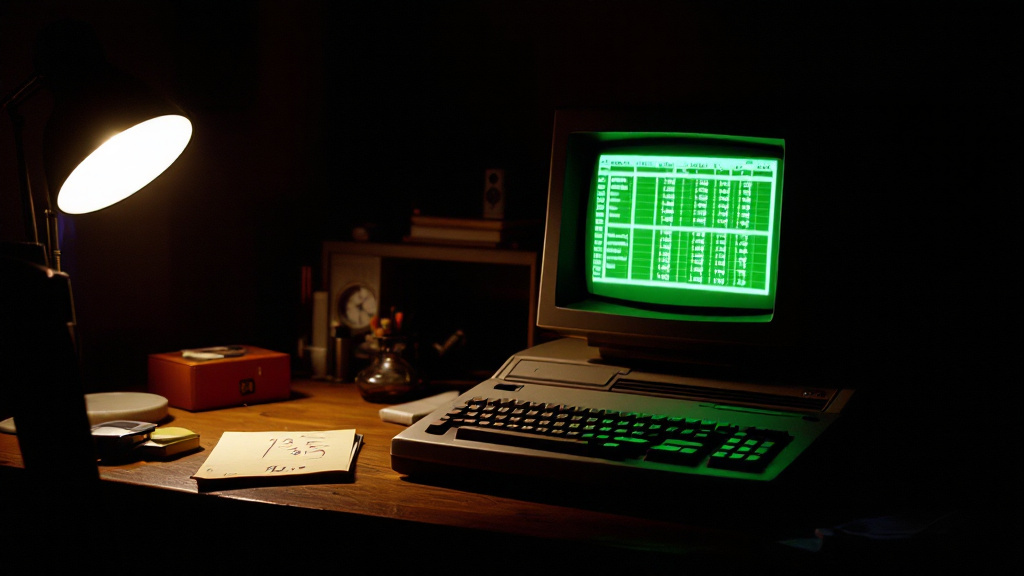
The computer spreadsheet didn’t come from a tech giant. It came from a bored Harvard MBA student staring at a chalkboard. That single moment of frustration in 1978 quietly changed business, design, and even how we think about data. Most people use spreadsheets every day without knowing their strange, brilliant origin story. It’s one of the most important software inventions ever made. And almost nobody talks about it.
The Computer Spreadsheet Nobody Asked For
A Chalkboard That Started Everything
Dan Bricklin was sitting in a Harvard Business School lecture. His professor kept erasing and rewriting numbers on a chalkboard. Every small change meant redoing the entire calculation. Bricklin thought there had to be a better way. So he imagined a magic blackboard — one that recalculated everything automatically. That image became the blueprint for VisiCalc, the world’s first computer spreadsheet. It launched in 1979. It ran on the Apple II.
The Partner Who Made It Real
Bricklin couldn’t code the whole thing alone. He brought in Bob Frankston, a programmer he trusted deeply. Together, they built VisiCalc in a tiny attic apartment. Frankston often coded through the night to squeeze the program into limited memory. The Apple II only had 32 kilobytes of RAM. That’s less than a single small image file today. Yet somehow, they made it work. The result was something nobody had seen before.
The Release That Shocked Everyone
VisiCalc launched in October 1979. It cost $99.99. Within two years, it sold over 100,000 copies. That was an almost unheard-of number for software back then. But here’s the really wild part — people started buying Apple II computers just to run VisiCalc. The software was selling the hardware. It became the first true “killer app” in personal computing history.

Why the Computer Spreadsheet Changed Everything
Accountants Got Superpowers
Before VisiCalc, financial modeling meant pencils, paper, and hours of manual arithmetic. One wrong number cascaded into dozens of errors. Fixing it took forever. With the computer spreadsheet, you changed one cell. Everything else updated instantly. Accountants and business analysts suddenly worked ten times faster. CFOs could model scenarios in minutes instead of days. It didn’t just speed things up — it changed what was even possible to ask.
Design and Visual Thinking Got Involved
Here’s something most people miss. The grid layout of a spreadsheet was itself a design decision. Bricklin thought visually first. He wanted rows and columns to feel natural and readable. That spatial logic — organizing information in visible, structured cells — influenced how designers later thought about data layout. Infographics, dashboards, and data visualization all carry a little VisiCalc DNA. KREAblog has covered how design thinking shapes technology. This is a perfect early example.
Lotus and Excel Finished What VisiCalc Started
VisiCalc’s creators made a critical mistake. They didn’t patent the core concept. So competitors studied it, improved it, and moved fast. Lotus 1-2-3 arrived in 1983 and dominated the IBM PC market. Then Microsoft Excel launched in 1985, first on Mac, then on Windows. Each version added more power and smarter design. But none of it exists without that attic in Cambridge, Massachusetts. Bricklin and Frankston never got truly rich from their invention. That’s a painful irony worth sitting with.
What It Still Means Today
Spreadsheets now run much of the global economy. Banks model risk in them. Scientists track experiments in them. Filmmakers budget productions in them. Even AI training datasets often start as spreadsheets. The computer spreadsheet became so embedded in human thinking that we barely notice it anymore. That invisibility is actually a sign of how completely it won. The best tools disappear into daily life. VisiCalc did exactly that — just without getting the credit it deserved.
Bricklin once said he didn’t set out to change the world. He just wanted to stop watching a professor erase numbers on a chalkboard. Sometimes the most important inventions start with the smallest annoyance. That’s worth remembering the next time you open a blank grid and start typing.
This article is for informational purposes only.