
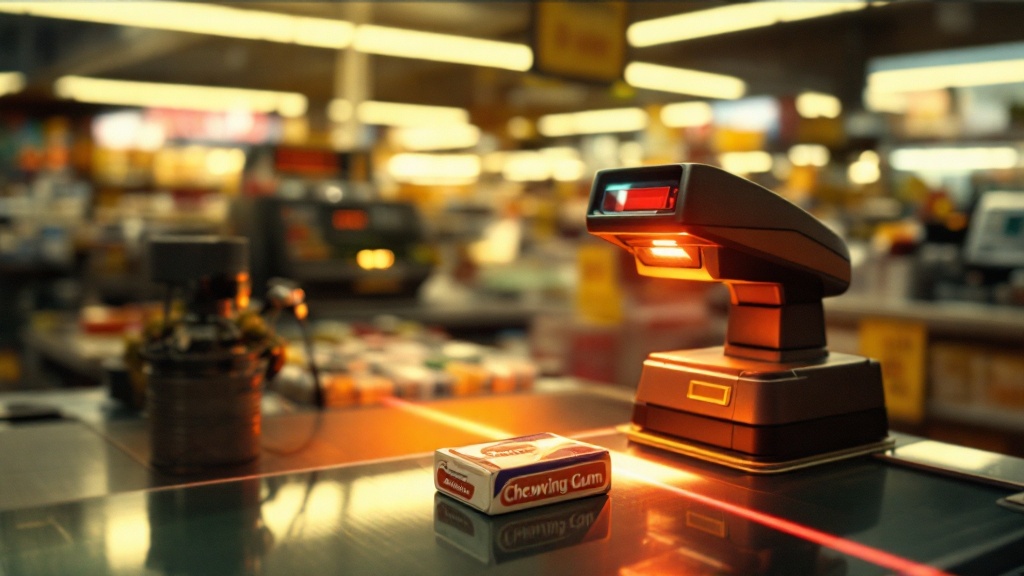
The first barcode ever scanned in a real store happened on June 26, 1974. It was a quiet Tuesday morning in Troy, Ohio. A cashier named Sharon Buchanan picked up a 10-pack of Wrigley’s Juicy Fruit gum. She ran it across a brand-new laser scanner. The machine beeped. History happened. That pack of gum now lives in the Smithsonian Institution. Most people have no idea.
But the road to that beep was long. It took nearly 30 years of failure, ridicule, and obsession. It involved a beach, a patent, and one engineer who drew in the sand. That’s where this story really starts.
The First Barcode Was Drawn on a Beach
In 1948, a graduate student named Bernard Silver overheard something strange. A supermarket executive was begging a professor for help. He wanted a system to read product information automatically. The professor said no. Silver said yes.
Silver teamed up with his friend Norman Woodland. Woodland was brilliant and restless. He quit his PhD program to focus entirely on this idea. Then he did something unexpected. He moved to his grandfather’s Miami Beach apartment and started thinking in the sand.
The Morse Code Connection Nobody Talks About
Woodland knew Morse code well. One afternoon, he dragged his fingers through the beach sand. He stretched the dots and dashes of Morse code into long lines. Thin lines and thick lines. Suddenly, it clicked. That pattern could carry data. A machine could read it with light.
It was a genuinely beautiful idea. Simple. Elegant. Totally ahead of its time. Woodland and Silver filed a patent in 1949. They called it a “Classifying Apparatus and Method.” Nobody in retail cared.
The Idea That Sat in a Drawer for 25 Years
The patent expired. The technology to actually read a barcode didn’t exist yet. Lasers weren’t even a thing in 1949. So the idea sat quietly, waiting. RCA bought the patent eventually. Then IBM got involved. Then a grocery industry group got serious in the early 1970s. Finally, after years of committee meetings, they agreed on a standard. The Universal Product Code was born. And Sharon Buchanan got her scanner.
Why the First Barcode Scan Almost Didn’t Matter
Here’s the thing retailers forget. The first barcode scan was a massive flop — commercially speaking. Stores didn’t rush to install scanners. The machines were expensive. Cashiers were suspicious. Customers didn’t trust prices they couldn’t see printed on products. For years, adoption was painfully slow.
In 1976, KREAblog-worthy drama unfolded. BusinessWeek ran a headline calling the barcode “the supermarket scanner that fell flat.” Only about 200 stores had scanners installed. The industry had invested millions. It looked like a very expensive mistake.
The Turning Point Was About Speed, Not Tech
So what saved the barcode? Speed. A simple human truth. Cashiers with scanners processed groceries two to three times faster. Store managers noticed checkout lines shrinking. Inventory tracking became suddenly accurate. The business case became impossible to ignore. By 1980, thousands of stores had scanners. By 1990, they were everywhere.
The barcode didn’t win because it was clever. It won because it made people’s lives faster. That’s a lesson worth remembering.
Norman Woodland Never Got Rich From It
Woodland sold his share of the original patent to RCA for around 15,000 dollars. That was real money in 1952. But given what the barcode became? It was one of the worst deals in tech history. Woodland later worked at IBM, even helping develop the UPC standard. He got to see his beach-sand idea reshape global commerce. In 2011, President Obama gave him the National Medal of Technology. Woodland died in 2012. He was 91 years old.
What the First Barcode Actually Changed Forever
The first barcode didn’t just speed up checkout. It created the modern supply chain. Before barcodes, inventory was tracked by hand. Mistakes were constant. Theft was hard to detect. Pricing errors were everywhere. The barcode introduced machine-readable truth into retail. That was radical.
Also, barcodes made big data possible before anyone called it big data. Every scan is a data point. Every beep tells a story. Retailers could suddenly see what was selling, where, and when. That changed how products were made, shipped, and priced globally.
Today’s QR codes, NFC chips, and RFID tags are all direct descendants of Woodland’s sand drawings. Even the way AI tracks consumer behavior in stores traces its roots back to that Troy, Ohio morning. One beep. One pack of gum. One enormous ripple through history.
What’s wild is how close it came to never happening. One professor said no. One grad student said yes. One engineer decided a beach was the right place to solve an industrial problem. Sometimes the most important moments in history start with someone dragging their fingers through sand and wondering what patterns might mean.
This article is for informational purposes only.